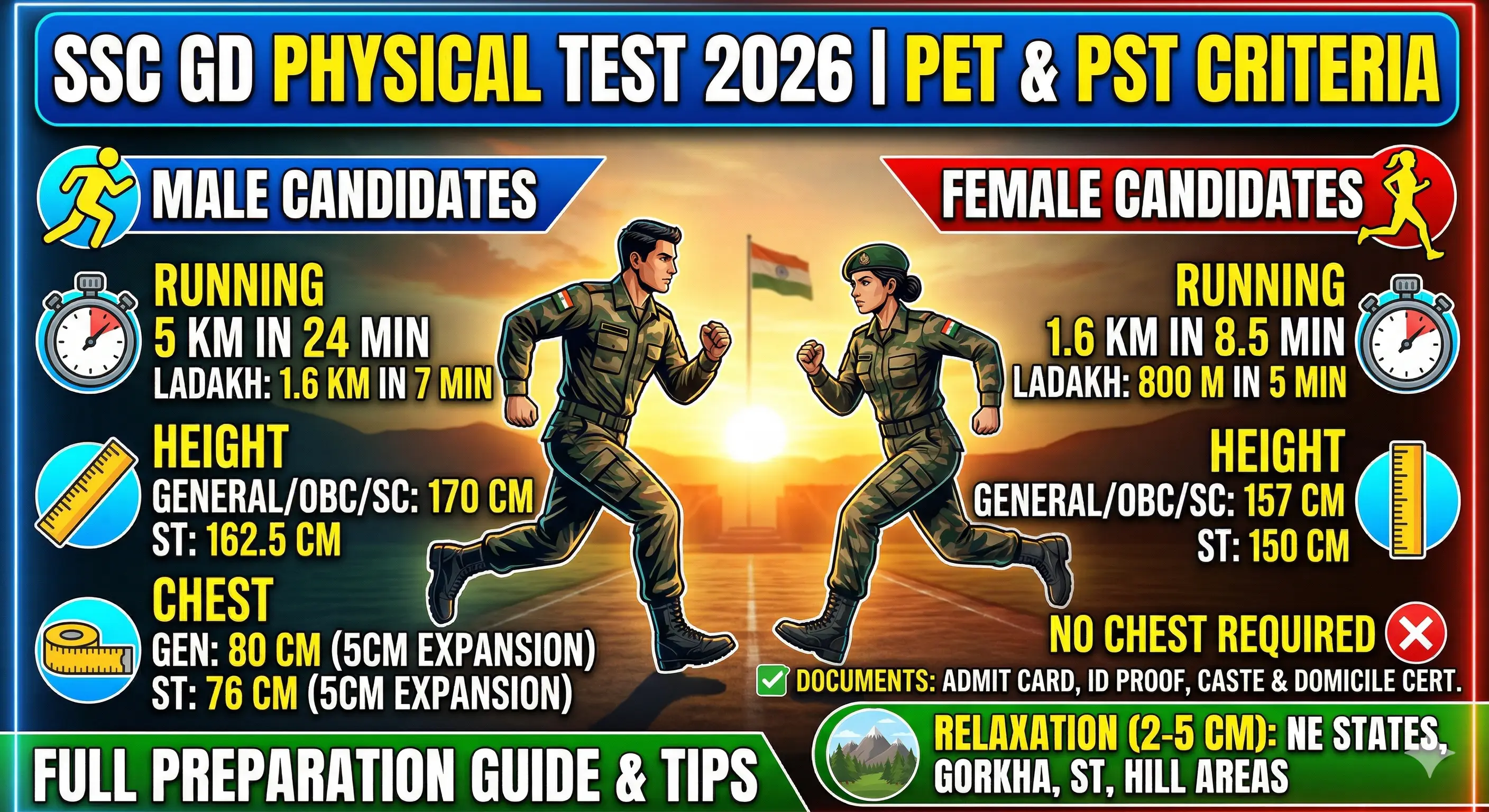
If you are preparing for Indian Army Agniveer Recruitment 2026, then understanding the Agniveer Physical Test requirements is very important. Every candidate must clear the Physical Fitness Test (PFT) before appearing for the medical and written exam.
In this article, we will explain the complete Agniveer Physical Test Details 2026 including running time, height requirement, chest measurement, weight chart, push-ups, and preparation tips.
Agniveer Physical Test 2026 Overview
| Test | Details |
| Organization | Indian Army |
| Scheme | Agnipath Scheme |
| Recruitment | Agniveer |
| Selection Process | Physical Test → Medical Test → Written Exam |
| Physical Test Type | Physical Fitness Test (PFT) |
Candidates must pass the physical fitness test during the Army rally recruitment.
Army Physical Test Requirements (Agniveer 2026)
The Agniveer Physical Fitness Test (PFT) mainly includes:
- 1600 Meter Run
- Pull-Ups (Beam)
- 9 Feet Ditch Jump
- Zig-Zag Balance
Candidates must qualify in all stages.
1600 Meter Run Time (Race Timing)
The 1600 meter running test is the most important part of the physical exam.
| Group | Time | Marks |
| Group 1 | Up to 5 min 30 sec | 60 Marks |
| Group 2 | 5 min 31 sec to 5 min 45 sec | 48 Marks |
Important points:
- Candidates finishing within 5 min 30 sec get maximum marks.
- After 5 min 45 sec, candidates are disqualified.
Pull-ups (Beam) Marks
After the run, candidates must perform pull-ups on a beam.
| Pull-ups | Marks |
| 10 | 40 |
| 9 | 33 |
| 8 | 27 |
| 7 | 21 |
| 6 | 16 |
Minimum 6 pull-ups are required to qualify.
Height Requirement for Agniveer
The minimum height requirement varies depending on region and category.
| Category | Minimum Height |
| General / Most States | 170 cm |
| Gorkhas | 157 cm |
| Garhwali / Kumaoni | 163 cm |
| North East States | 160 cm |
Candidates must check the official rally notification for exact height criteria.
Chest Measurement Requirement
Chest measurement is another important physical standard.
| Requirement | Measurement |
| Minimum Chest | 77 cm |
| Chest Expansion | 5 cm |
Example:
77 cm → 82 cm after expansion.
Weight Requirement (Army Weight Chart)
Weight must be proportionate to height and age.
Example:
| Height | Minimum Weight |
| 170 cm | 50 kg |
| 173 cm | 52 kg |
| 175 cm | 55 kg |
| 178 cm | 58 kg |
Exact weight is verified during the medical examination.
9 Feet Ditch Jump
Candidates must successfully jump across a 9 feet ditch.
This test checks:
- Body balance
- Leg strength
- Agility
Failure results in disqualification.
Zig-Zag Balance Test
Candidates walk through a zig-zag balance beam.
Purpose:
- Test body coordination
- Test balance ability
This test is qualifying in nature.
Agniveer Physical Test Preparation Tips
If you want to pass the Army physical test easily, follow these tips:
1. Daily Running Practice
Run 2–3 km every morning to improve stamina.
2. Increase Pull-ups Strength
Practice pull-ups daily on a bar.
Start with:
- 3 pull-ups
- Increase gradually to 10+ pull-ups
3. Maintain Proper Diet
Eat healthy foods like:
- Milk
- Eggs
- Bananas
- Green vegetables
- Dry fruits
4. Practice Sprint Training
Running drills improve speed for the 1600m race.
5. Maintain Proper Weight
Avoid junk food and keep BMI balanced.
Selection Process for Agniveer Recruitment
The Indian Army Agniveer selection process includes:
1️⃣ Physical Fitness Test (PFT)
2️⃣ Physical Measurement Test (PMT)
3️⃣ Medical Examination
4️⃣ Common Entrance Exam (CEE)
Only candidates who pass the physical test can appear for the written exam.
Important Tips for Army Rally Candidates
- Reach the rally ground early in the morning.
- Wear light running shoes.
- Carry admit card and ID proof.
- Drink water but avoid heavy meals before the race.
Conclusion
The Agniveer Physical Test 2026 is the first and most important step in joining the Indian Army under the Agnipath scheme. Candidates must prepare seriously for running, pull-ups, and physical standards to qualify for the next stage.
With proper training and discipline, you can easily clear the Army physical test and move toward becoming an Agniveer.